
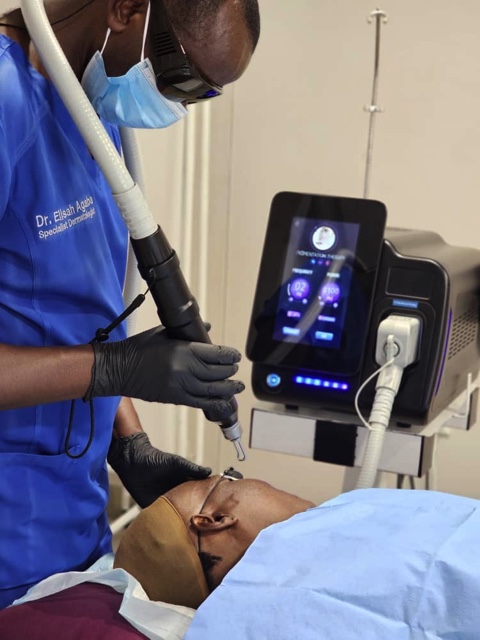
LASER IN DERMATOLOGY
The demand for aesthetic procedures is significantly increasing worldwide. Minimally invasive techniques used in enhancing facial aesthetics are becoming more popular due to their lower complication rates and faster onset of recovery compared to surgical interventions.
What is laser
The word “LASER” is an acronym that stands for Light Amplification by the Stimulated Emission of Radiation. Professor Albert Einstein (Einstein) published all of the necessary formulas and theoretical concepts to build a laser in his 1917 treatise called “The Quantum Theory of Radiation.” even though the first true laser was introduced to the market in 1960, a ruby laser, was operated by Dr. Theodore H. Maiman.
The last word in the acronym, “radiation,” is a common source of patient anxiety since it can be associated with the high energy ionizing radiation often used for cancer radiotherapy. However, in the case of lasers, the word is employed to describe how the laser light is propagated through space as “radiant” waves. Patients should be assured that all currently approved medical lasers are incapable of ionizing tissue and have none of the risks associated with the radiation used in cancer therapy. All lasers are composed of the same four primary components. These include the laser medium (usually a solid, liquid, or gas), the optical cavity or resonator which surrounds the laser medium and contains the amplification process, the power supply or “pump” that excites the atoms and creates population inversion, and a delivery system (usually a fiber optic or articulating arm with mirrored joints) to precisely deliver the light to the target.
What makes lasers so effective
Lasers can accurately send hyper-focused energy in the form of light or radiofrequency to very small, specific locations. laser can target specific cells without damaging surrounding tissue. the aesthetician can control the laser and the amount of energy that reaches the skin to specifically target the areas of concern and help reach the goals.
To Maximizing the benefits of laser treatment combining the power of different types of lasers to maximize the benefits of treatments. lasers are a focused beam of light that uses a singular color to target a certain area on the skin (like a brown spot or an unwanted hair follicle) while leaving the skin around it completely unharmed.
Different types of lasers
Pulsed dye lasers, along with other laser types, are effective for treating vascular lesions like port- wine stains and spider veins. Lasers like the Q-switched Nd:YAG and ruby lasers are used for treating pigmented lesions, including tattoos. Ablative and non-ablative lasers are used for skin resurfacing, addressing conditions like wrinkles, scars, and sun damage. Lasers are used to remove unwanted hair by targeting the melanin in the hair follicles. Lasers are also used for wound healing, treating certain skin conditions like psoriasis and vitiligo, and for removing precancerous skin lesions. Are laser treatments covered by medical aid?
All medical treatments done by a registered dermatologist for medical conditions can be covered by medical aid.

