
MEAT CHRONICLE 1/2026
Acting CEO appointed Farewell to a valued leader
We are pleased to announce the appointment of Goliath Tujendapi as the acting chief executive of the LLPBN, effective 1 December 2025. Mr Tujendapi brings extensive experience, industry insight and a commitment to the LLPBN’s mission. We are confident that he will provide stable and capable leadership during this transition period. At the same time, we would like to acknowledge the retirement of Paul Strydom from the LLPBN on 30 November 2025. We extend our sincere gratitude for his decades of dedicated service and leadership. The LLPBN wishes him well-deserved rest, quality time with his family and the opportunity to enjoy his personal projects. Please join us in welcoming Mr Tujendapi to his new role and in wishing Mr Strydom all the best for the future.


Career profile Goliath Kambaurona Tujendapi
In the evolving landscape of global agriculture, leadership requires a fusion of deep-rooted heritage, technical mastery and a proactive vision. As the acting chief executive officer of the Livestock and Livestock Products Board of Namibia (LLPBN), Goliath Kambaurona Tujendapi is steering Namibia toward a new era of industry resilience and global prestige.
A journey of commitment and proficiency
Born in 1971 in Windhoek and raised in the village of Otjinene, Tujendapi’s connection to the land is personal and profound. He is a seasoned livestock farmer.
He spent years as an agricultural extension officer, providing advice and guidance to livestock farmers. His journey to the helm of the LLPBN is supported by a robust academic foundation, including a Master of Business Leadership (MBL) from the University of South Africa, an Honours degree in Agricultural Management from the University of the Free State, a Bachelor’s degree in Agricultural Technology from Port Elisabeth Technicon and a National Agricultural Certificate from the Tsumis Agricultural College.
With over three decades (since 2002) of strategic experience, he has served the LLPBN in multiple capacities. From his early work in marketing and international trade negotiations to his recent roles in executive management, he has been central to developing strategic frameworks such as the Drought Policy Framework, National Rangeland Management Policy and Strategy, the Trade Strategy and the Livestock Products Branding Strategy.
His career is defined by an ability to navigate complex international requirements, from the European Union to regional African markets, always advancing Namibia’s global interests.
Owning the vision: Resilience and growth
Tujendapi views the vision of a globally competitive Namibian livestock sector as a personal mandate, focusing his leadership on six pillars designed to significantly boost agricultural GDP:
- Prioritising operational efficiency by streamlining LLPBN services to reduce producer transaction costs
- Driving cost reduction alternatives for primary production
- Value enhancement through the entire livestock and livestock industry value chain
- Strategic innovation through the adoption of Wagyu production and advanced genetic enhancement to elevate Namibia’s trusted meat brand
- Unlocking the untapped potential of the livestock industry in Namibia’s communal areas north of the veterinary cordon fence via market-oriented animal husbandry, genetic improvement and market development,
- and securing the industry’s rightful place in global markets by leveraging the unique and natural characteristics of Namibia’s production environment to command premium value.
Leadership through synergy
Tujendapi champions a philosophy of inclusive, collective leadership. A keen listener, he leverages expertise from both within and outside the LLPBN to build sustainable industry synergies. By fostering a high-performance, professional workforce and nurturing strategic relationships, he drives an enabling environment necessary for the Namibian livestock sector to withstand global shocks.
“We cannot simply participate in the global market. We must define the standards of quality,” says Tujendapi. “My commitment is to ensure the LLPBN acts as an engine of efficiency. One that empowers producers, respects Namibian heritage and secures a competitive edge on the world stage through innovation, inclusivity and market insight.”
As the industry moves forward, it does so under the guidance of a leader whose decisive, focused mindset is dedicated to ensuring that the Namibian livestock sector remains a sustainable and highly valued contributor to the nation’s economy
LLPBN and Trans-Kalahari Corridor Secretariat commit to prevent the spread of FMD
The Trans-Kalahari Corridor Secretariat (TKCS) and Namibia’s Livestock and Livestock Products Board have pledged urgent collaboration to prevent the spread of foot-and-mouth disease (FMD) – a major threat to trade and economic stability in the region.
On 17 February, TKCS executive director Leslie Mlungisi Mpofu paid a courtesy visit to the LLPBN’s acting CEO, Goliath Tujendapi. Discussions centered on the risks posed by FMD to cross-border trade along the Trans-Kalahari corridor. Goliath emphasised that FMD is not only a livestock issue but a trade- and economic-disease capable of disrupting multiple industries.
Both leaders agreed that prevention is more effective than control, calling for the TKCS to convene stakeholders from member states to design joint strategies and launch public awareness campaigns. The iniatitive aims to safeguard the seamless movement of goods and people across the border, reinforcing regional co-operation against the disease.
The TKCS continues to work closely with key partners to ensure resilience in trade and transport, underscoring the corridor’s role as a vital link for Southern African economic integration.
Livestock board supports DVS
Namibia has officially launched a FMD Support Fund and appointed 25 members to a National FMD Task Force. This is a decisive move to protect the country’s N$15 billion livestock industry from the threat of FMD entering the nation’s FMD-free zone.
The launch held on 26 February 2026 at the Ministry of Agriculture, marked a significant step in strengthening Namibia’s biosecurity and trade resilience. Dr Anja Boshoff-De Witt (LLPBN Manager: Meat Standards) and Desmond Cloete (Marketing Manager) will represent the Livestock and Livestock Products Board of Namibia on the task force.
At the event, a total of N$11 million was pledged by various industry stakeholders and key role players such as Bank Windoek, Agra, Feedmaster, Namib Mills, Agrimark, the NAU, FNB and the DAS Group towards the FMD Support Fund. The fund is designed to enhance disease surveillance, reinforce biosecurity measures and improve national response capacity. These interventions are critical to safeguarding Namibia’s access to international export markets.
Officials warned that any outbreak of FMD in Namibia would trigger the immediate suspension of meat exports and cause long-term disruption to global trade relationships. The combined efforts of the support fund and task force will aim to prevent such risks, ensuring the continued growth and stability of the Namibian livestock sector.
Farmers and the public urged to help protect Namibia’s FMD-free status
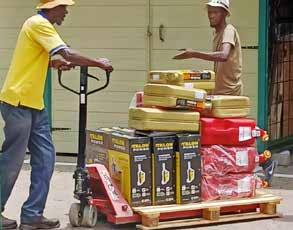
The LLPBN’s contribution to the control of foot-and-mouth disease (FMD) includes the provision of personnel at all border posts between Namibia and South Africa for the disinfection of vehicles and the operation of footbaths. The LLPBN also supplies disinfection equipment and sufficient informational material.
Furthermore, awareness campaigns have been launched in collaboration with the Directorate of Veterinary Services (DVS) and the Namibia Agricultural Union (NAU), featuring visual guidelines on notifiable diseases in Namibia. This includes protocols for suspected cases.
Information cards, with the emergency contact numbers of all state veterinarians (see page 2) south of the veterinary cordon fence (VCF), have been printed and posted. Funds have also been allocated for the construction of drive-through baths to disinfect vehicles and trucks at the Ariamsvlei and Noordoewer border posts.
Funds have also been made available for a mobile FMD emergency stock storage facility in Windhoek. The emergency store is housed in a container designed for rapid deployment and can be moved immediately to a suspected outbreak site upon request from the DVS. The initiative forms part of the country’s proactive approach to safeguarding the livestock sector against the severe economic and trade impact of an FMD outbreak.
Namibia’s FMD-free status underpins the country’s access to premium international meat markets, supports thousands of farmers and workers, and helps maintain trade credibility.
FMD is a highly contagious viral disease affecting cloven-hoofed animals such as cattle, sheep, goats and pigs. Although it does not affect humans, it can spread between animals and cause severe economic losses. Farmers are urged not to move animals without a valid permit, immediately report sick animals to the nearest veterinarian and to fully comply with veterinary regulations.
In the meantime, the LLPBN is facilitating discussions between the industry and DVS on risk management and additional measures for trucks transporting livestock. Other long-term actions for the prevention of FMD include the inspection of older fences that may require maintenance and ongoing repair and upgrading of existing veterinary fences.
Implementation of cashless transactions
We wish to inform all producers and stakeholders that the LLPBN is transitioning to a fully cashless payment system at its offices to reduce administrative costs and minimise the risks associated with handling cash. Producers are encouraged to use debit/credit cards or electronic funds transfer (EFT) for payments related to the Livestock and Livestock Products Board, including stock brand applications and ear tag purchases.
THE INTENDED DATE OF IMPLEMENTATION IS 1 APRIL 2026
LLPBN hosts veterinary medicine students
The LLPBN hosted 2nd year veterinary medicine students from the University of Namibia’s (UNAM). This is an annual event where students, as part of their animal production farm visit module, are exposed to the mechanics of the Namibian livestock sector. They gain vital knowledge and skills in animal production, processing and market access as a net exporter of red meat and its products. Desmond Cloete, the LLPBN’s marketing manager, provided an overview of the roles and functions of the LLPBN as the official regulator of the sector. Victor Klazen, the manager for FAN Meat, explained its critical importance as an assurance scheme in market access.
Livestock and meat industry fourth quarter 2025 performance
This article reviews the performance of cattle, small stock and pork marketing. It will cover and compare 2025 with the corresponding 2024 period.
Cattle sector
Cattle marketing witnessed structural shifts during the period under review.
Production and marketing
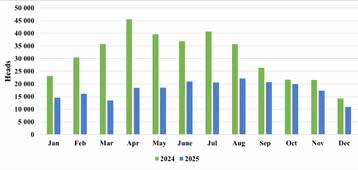
- Year-to-date, 213 962 cattle were marketed across all channels. This represents a 42,5% decline compared to the 371 982 heads marketed in 2024.
- Year-to-date, 59 224 heads were exported live to neighbouring SADC member states, while 101 294 heads were slaughtered at A-class abattoirs, and 53 444 were slaughtered at various registered Livestock and Livestock Products Board of Namibia (LLPBN) B- and C-class abattoirs.
- B- and C-class abattoirs slaughtered 53 444 heads of cattle during 2025, while throughput during the corresponding 2024 period stood at 58 691 heads of cattle. This is a decline of 8,9%.
- Export abattoirs took up 47,3% of the total number of cattle marketed in 2025, live exports 27,7% and B- and C-class abattoirs absorbed 25%. Compared to 2024, A-class abattoirs and B- and C-class abattoirs gained 11% and 9% of the market share, while live exports lost 20%.
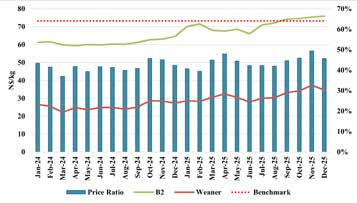
- During the period under review, domestic weaner prices at auction reached higher levels. The average weaner price south of the veterinary cordon fence (VCF) increased to N$31.47 per kg in 2025. During the corresponding 2024 period, the average price was N$25.49 per kg.
- The average tolly price north of the VCF was N$30.06 per kg. The highest and lowest prices of N$36.49 and N$21.57 were recorded in November and July, respectively.
- B2 producer carcass price increased by N$10.11 per kg and averaged N$71.24 per kg, relative to the N$61.13 paid to producers during the corresponding period in 2024.
- The Red Meat Abattoir Association (RMAA) came in N$13.08 per kg lower than its Namibian counterpart and averaged N$58.16 per kg in 2025 compared to the N$46.92 per kg recorded in 2024.
Sheep sector
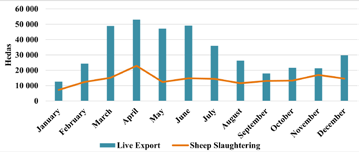
Year-to-date, 557 119 sheep were marketed across all channels. This represents a decline of 30,8% from the 804 519 heads marketed in the same quarter of 2024.
Production and marketing

- In 2025, live exports recorded a 37,2% decrease, A-class abattoirs a decrease of 11,04%, and B- and C-class abattoirs a decrease of 8,6% compared to 2024.
- Live exports of sheep declined significantly by 37,2%, recording 388 337 heads in comparison to the 617 706 recorded during the corresponding 2024 period.
- The market share for live sheep exports decreased by 7% during the period under review, from 77% recorded during 2024.
- The market share for both export-approved abattoirs and B- and C-class abattoirs increased by 3% and 5%, respecticely for the period under review. In the corresponding 2024 quarter they were 9% and 14%.
- The price difference between Namibia sheep export abattoirs and Northern Cape abattoirs reduced, remaining in favour of Northern Cape producers. The average was negative at N$2.57 per kg compared to the positive price differencial of N$4.52 per kg recorded in 2024.
- The Namibian A2 producer price on average traded at N$94.18 per kg during the period under review, whereas the Northern Cape A2 producer price averaged N$96.75 per kg – N$2.57 higher than the Namibian A2 producer price.
- Northern Cape producer prices serve as a benchmark for Namibian producers, given that the majority of sheep exports are destined for the Northern Cape region.

Goat sector
The goat sector increased during the fourth quarter of 2025, compared to 2024. Year-to-date, 134 728 goats were marketed across all channels, representing a slight decline of 5,2% from the 142 103 heads marketed during the same 2024 quarter.

Production and marketing
- Live exports of goats decreased by 6,01%, recording 131 249 heads compared to the 139 645 in the 2024 comparable period. Slaughtering increased significantly by 41,5%, recording 3 479 heads in 2025. In 2024 the total was 2 458 heads.
- From the total number of goats marketed during the period under review, 97,4% were live exports, while B- and C-class abattoirs accounted for 2,6%.
Pork sector
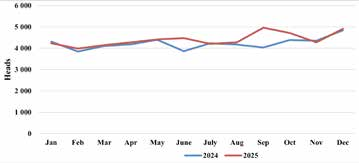
Pig slaughtering activities at LLPBN-registered abattoirs recorded a growth in 2025. Year-to-date, 53 080 pigs were marketed, where live exports took up 211 (0,4%) heads and slaughtering accounted for 52 869 heads (99,6%), representing an increase of 4,7% compared to the 50 719 heads marketed in the fourth quarter of 2024.

Production and marketing
- The pork market share remained in favour of imports due to increased pork imports. Excluding processed products, the local pork products’ market share increased slightly by 0,3% from the 46,6% in 2024 to 46,9% in 2025. Imports decreased from 53,4% to 53,01%.
- Local pork production serviced 46,9% of the Namibian consumption demand (including processed pork) during the period under review. The average slaughter mass of pigs in 2025 averaged 90,3 kg.
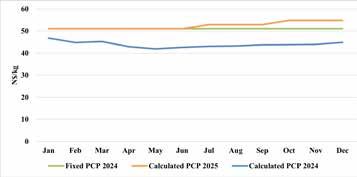
- The pork-ceiling price in 2025 stood at N$52.45 per kg, while the benchmark Red Meat Abattoir Association (RMAA) price in South Africa averaged N$34.14 per kg during the period.
Conclusion
Overall, livestock marketing in 2025 reflected a sector operating under recovery and adjustment conditions, characterised by constrained livestock supply, with cattle marketing and slaughter remaining below 2024 levels due to ongoing herd recovery.
Producer prices across most commodities remained higher than in 2024 with slight fluctuations month-on-month, largely supported by seasonal market dynamics.
Looking ahead, livestock marketing in 2026 is expected to remain supply-constrained in the short term, particularly in the cattle sector, as herd recovery and rebuilding dynamics continue to limit slaughter availability. Therefore, livestock marketing volumes are expected to remain gradual and biologically driven, with meaningful volume improvements dependent on improved animal availability rather than shifts in market demand.
The LLPBN continues to monitor FMD outbreak developments in neighbouring South Africa and Botswana, and is working with stakeholders to ensure coordinated preventative measures as well as a robust risk management plan for the livestock sector.

