- Advertorial
Procurement: The Silent Engine Powering Responsible Mining
Mining is often judged by what happens at the rock face: drilling, blasting, hauling and processing. These visible activities shape public perception of the industry. Yet behind every successful mining operation lies a quieter force that determines whether production targets are met, costs are controlled, and standards are upheld. That force is procurement.
To those outside the industry, procurement may simply appear as “purchasing”, but it is one of the most strategic functions within a modern mining business. It connects operations to complex national and global supply networks, translates corporate strategy into practical execution, and quietly safeguards the long-term sustainability of a mine.
In Namibia, where mining remains a cornerstone of the economy, procurement plays an especially critical role. Operations are often located far from ports and industrial centres. Supply routes stretch across long distances. Environmental conditions can be harsh. Under these circumstances, ensuring that equipment, spare parts, consumables and services arrive on time and of the right standard is not a routine administrative task. It is a disciplined strategic effort.
Mining is a cyclical industry. Commodity prices fluctuate, global markets shift, and cost pressures intensify during downturns. Procurement sits at the centre of cost discipline. But modern procurement is no longer about negotiating the lowest price. Leading mining companies focus instead on total cost of ownership, considering quality, durability, service support, logistics complexity and operational risk.
In the Namibian context, this approach is particularly important. A component that fails prematurely does not simply require replacement. It may involve extended transport timelines, production delays and costly downtime. The cheapest option on paper can quickly become the most expensive in practice. For companies managing long-life assets, disciplined long-term value creation must outweigh short-term savings.
Reliability is another area where procurement’s influence is profound, though often unseen. Namibia’s mining landscape is defined by distance between mines, ports and suppliers. Logistics planning is therefore inseparable from procurement planning. Forecasting demand accurately, maintaining appropriate inventory levels and coordinating transport across vast geographies are essential to keeping operations stable.
When procurement performs well, production continues uninterrupted. When it does not, the impact can be immediate: halted processing plants, idle equipment and missed output targets. Reliability is not accidental. It is engineered through careful supplier selection, contract management and supply chain oversight.
Risk management is equally central to the procurement function. Supply chain concentration poses a real challenge, particularly where specialized mining equipment or consumables are sourced from a limited pool of international manufacturers. Global disruptions, whether from manufacturing slowdowns, port congestion or geopolitical tensions, can quickly affect availability on site.
Logistics risks add another layer of complexity. Fuel price volatility, transport bottlenecks and infrastructure constraints all influence delivery timelines and cost structures. Effective procurement integrates contingency planning, supplier diversification and regional sourcing strategies to reduce exposure.
Regulatory compliance and governance also demand attention. Mining companies operating in Namibia must meet national procurement requirements, localization expectations and strict ethical standards. Supplier due diligence, transparent contracting processes and strong oversight mechanisms are essential not only for compliance, but for maintaining public trust.
Procurement’s influence extends beyond cost and risk. It plays a direct role in safety and environmental performance. The quality of equipment, the standards applied by contractors and the compliance of suppliers all affect outcomes on the ground. Responsible sourcing and ethical supply chain practices ensure that corporate values extend beyond the mine gate.
Environmental, social and governance performance increasingly depends on procurement decisions. From supporting local suppliers to embedding sustainability criteria in contracts, procurement has become a lever for broader development impact. In a country where mining contributes significantly to economic growth, this responsibility carries weight.
The global operating environment continues to evolve. Supply chains face disruption from geopolitical tensions, climate-related events and shifting trade dynamics. Digital tools now allow procurement teams to improve forecasting, enhance data visibility and strengthen decision-making. The function is steadily moving from reactive problem-solving to proactive strategic planning.
Yet despite its strategic significance, procurement remains largely invisible to the public. It does not feature in photographs of blasting operations or processing plants. It does not capture headlines. But its fingerprints are present in every tonne produced safely, every cost target achieved and every compliance standard upheld
For mining professionals, procurement is recognised as a strategic partner. For the broader public, understanding its role offers a deeper appreciation of how modern mining companies operate responsibly, balancing efficiency with stewardship, profitability with accountability.
Namdeb Diamond Corporation
NAMDEB DIAMOND CORPORATION (PTY) LTD Namdeb is a wholly owned subsidiary of Namdeb (Proprietary Limited Holdings which is owned in equal shares (50:50) by the Government of the Republic of Namibia and De Beers. The heart of the operations is along the southwest coast of Namibia with land-based operations in Oranjemund and satellite mines near Lüderitz and along the Orange River (within the ML42, ML43, ML 44 and ML128-C mining license areas). Several types of innovative mining techniques are employed to extract diamonds from alluvial deposits of ore bodies. Namdeb is proud to be a significant contributor to the Namibian economy.
Did you know?
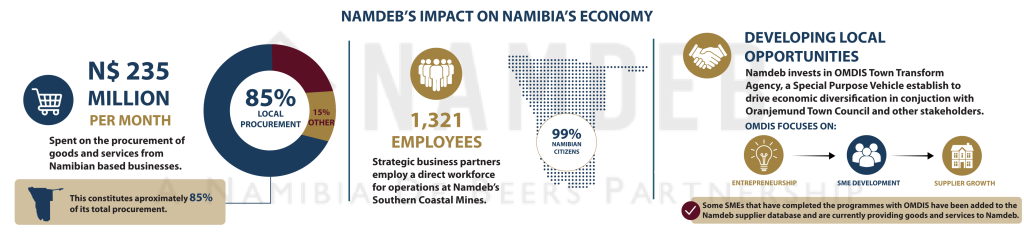
Procurement plays a critical role not only in operational efficiency, but also in driving local economic impact. For example, organisations that prioritise local sourcing can significantly strengthen domestic value chains. According to the 2025 Chamber of Mines report, Namdeb directs approximately 85% of its monthly procurement spend (around N$235 million) to Namibian-based businesses. Beyond spend, procurement decisions also influence employment and skills development, with Namdeb’s strategic business partners collectively employing over 1,300 people, the vast majority of whom are Namibian citizens. Importantly, leading procurement models are increasingly focused on supplier development, creating pathways for small and medium enterprises to participate in larger value chains. Organizations like the OMDIS Town Transform Agency, a section 21 company established by Namdeb demonstrate how procurement can be leveraged to foster entrepreneurship, integrate emerging suppliers into formal supply networks, and contribute to long-term economic transformation. As Namibian mining companies continue to pursue high standards of integrity and sustainable value creation, procurement will remain a quiet but decisive force. It may not stand at the rock face, but it powers everything that happens there.