
AGRIPRENEURIAL INNOVATION CHALLENGE AWARDS N$280,000 TO CLIMATE-SMART INNOVATORS STRENGTHENING NAMIBIA’S FOOD SYSTEMS
Windhoek, Namibia — 29 July 2026: Three high-potential innovators have been awarded the top prizes in the 2026 Agripreneurial Innovation Challenge Namibia, following the Challenge Finale and Awards Ceremony held at the Village Opera House in Windhoek.
The Agripreneurial Innovation Challenge is a national platform implemented by Basecamp Business Incubator in partnership with the Network for Global Innovation (NGIN), the Capricorn Foundation and the United Nations Industrial Development Organization (UNIDO).
The Challenge was established to identify and strengthen practical, climate-smart and job-creating innovations capable of improving Namibia’s agriculture value chain, food systems, productivity and value addition. It welcomed solutions across agricultural production, processing, water and irrigation, agritech, post-harvest management, market access, logistics, waste-to-value and other enabling areas.
The following innovators were announced as the Challenge winners:
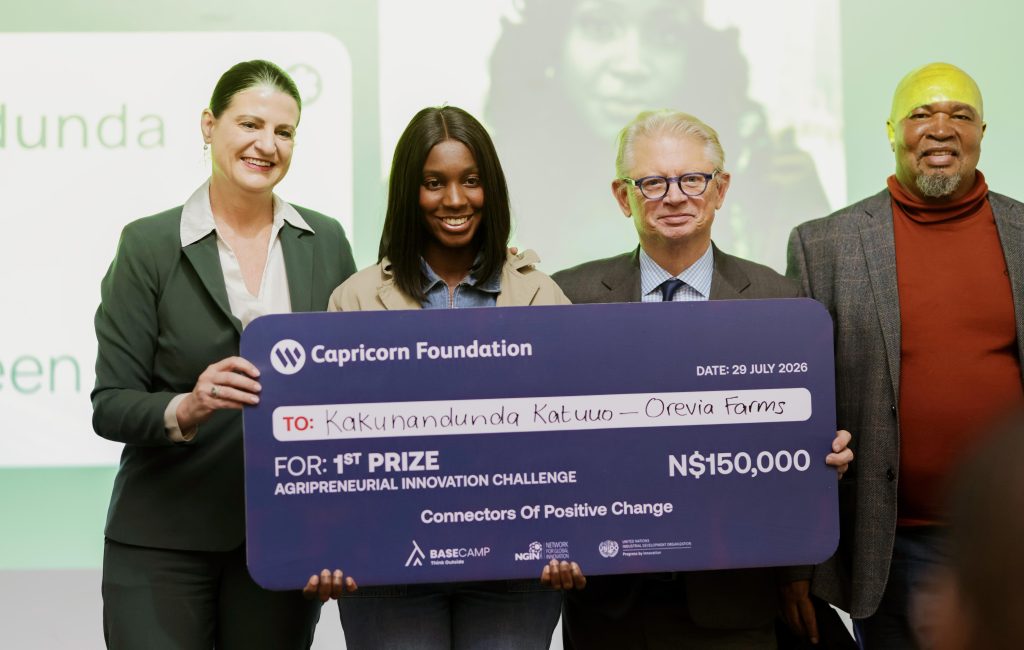
- First Prize — N$150,000: Kakunandunda Katuuo, Orevia Green Farms, a women-owned, women-led agricultural business specialising in high-quality vegetables like cabbage, carrots, beetroot, and potatoes.
- Second Prize — N$75,000: Abner Tomas, Ndaka Mushrooms & Processing, a mushroom farm and processing company focusing on sustainable cultivation, value addition, and entrepreneurship.
- Third Prize — N$50,000: Elizabeth Kambode, Lizwise Investment, a mushroom farm and processing company focusing on sustainable cultivation, value addition, and entrepreneurship.
- Best Women-Led Innovation — N$5,000: Maria Kativa, AutoSow, a solar-powered, precision-planting automation system designed specifically for smallholder farmers in rural African conditions to increase agricultural productivity and climate resilience.
The cash prizes, collectively valued at N$280,000, were sponsored by Capricorn Foundation as catalytic support to help the selected innovators further develop, test, implement or scale their solutions.
Speaking at the ceremony, Marlize Horn, Executive Director at the Capricorn Foundation, reaffirmed the Foundation’s commitment to Namibia’s entrepreneurial and innovation ecosystem.
“The Agripreneurial Innovation Challenge reflects the remarkable creativity, resilience and entrepreneurial ambition that exists across Namibia. At the Capricorn Foundation, we believe that when local innovators are given the right support, networks and opportunities, they can turn practical ideas into sustainable solutions that strengthen communities, create jobs and contribute meaningfully to Namibia’s future. These awards are more than prizes; they are investments in potential, progress and lasting impact.”
The Best Women-Led Innovation Award formed part of the Challenge’s intentional effort to recognise women’s leadership, resilience and contribution to agricultural innovation. Programme planning specifically provided for dedicated recognition that would encourage and amplify women-led enterprises.
The Challenge attracted 238 registrations, with 94 completed submissions received. Following eligibility screening and technical evaluation, 76 applicants progressed to the initial shortlist before the field was narrowed to the National Top 10 Finalists.
Applicants were progressively assessed on the problem addressed, the strength and originality of the proposed solution, practical feasibility, market potential, scalability, job-creation potential, team capability and expected climate impact.
The finalists, 70% of whom were women, also participated in a structured support journey that included applicant information sessions, proposal development, mentorship, pitch preparation and UNIDO-supported climate-impact guidance. The programme placed climate impact at the centre of the selection process, requiring applicants to consider their expected effects on areas such as emissions, energy use, materials, transport, waste and other environmental outcomes.
Fred Walti, President and CEO of NGIN, reflected on the importance of creating platforms that help promising innovations move beyond ideas.
“Innovation becomes meaningful when it moves beyond possibility and begins improving how people live, work and participate in the economy. This Challenge sought to do just that, by identifying and supporting solutions that can strengthen Namibia’s agriculture and food systems.”
Although the finale recognised the leading solutions, programme partners emphasised that the AIC was designed to create value beyond prize funding. Participants gained access to technical learning, mentorship, ecosystem visibility, networking and support to improve their readiness for future partnerships and investment opportunities.
Jesaya Hano-Oshike, Director of Basecamp Business Incubator, congratulated the winners and encouraged all finalists to continue building beyond the competition.
“To our finalists: congratulations once again. Today’s rankings are not the ceiling of your ambition. Leave with the conviction that your solution is worth continuing to build, and knowing that Basecamp remains committed to helping you as an entrepreneur to move from an idea to a viable enterprise.”
- Finalist 1 — Octavius Maketo, Ubuntu Aquatics – Male
- Finalist 2 — Elizabeth Kambode, Lizwise Investment – Female
- Finalist 3 — Klaudia Mwatile, Rudy Agritactic Machines – Female
- Finalist 4 — Kalinasho Augustus, Kalinasho Trading Enterprises – Female
- Finalist 5 — Jaziitha Simon, Hakuna Matata Engineering – Female
- Finalist 6 — Maria Kativa, AutoSow – Female
- Finalist 7 — Kakunandunda Katuuo, Orevia Green Farms – Female
- Finalist 8 — Abner Tomas, Ndaka Mushrooms & Processing – Male
- Finalist 9 — Simba Chanduru, Namabwe Permaculture Farm – Male
- Finalist 10 — Hul Hunsopheary, Evola (Singapore & Cambodia)– Female
Through the Agripreneurial Innovation Challenge, Basecamp, NGIN, the Capricorn Foundation and UNIDO reaffirm their shared commitment to supporting entrepreneurs who are building sustainable solutions, strengthening food systems and creating new economic opportunities through innovation.

