
UNLOCKING SUSTAINABLE GROWTH FROM NAMIBIA'S OCEAN RESOURCES
Strategic advantage
As countries around the world seek new pathways to sustainable economic growth, the blue economy has emerged as one of the most promising frontiers for development. For Namibia, with its Atlantic coastline, the blue economy presents significant opportunities to drive industrialisation, create jobs, strengthen food security and diversify the national economy.
Unlike traditional marine industries that focus primarily on resource extraction, the blue economy promotes responsible management of ocean resources by balancing economic development with environmental conservation. Namibia’s location along the Atlantic Ocean provides the country with a unique competitive advantage. The port of Walvis Bay serves as a strategic gateway to Southern Africa and connects regional markets to international trade routes. Combined with abundant marine resources, strong offshore wind potential and increasing investment in green hydrogen and renewable energy, Namibia is well positioned to become a regional leader in the blue economy.
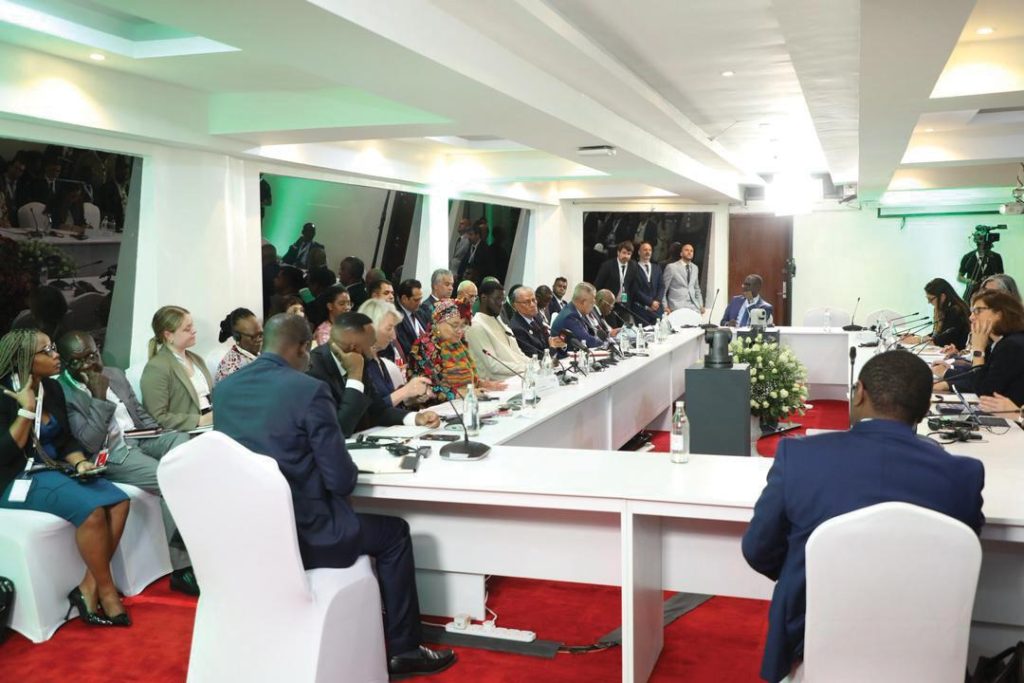
Speaking at the round table on the blue economy in Nairobi, Kenya, Vice President Lucia Witbooi said Africa must decide whether the blue economy will remain a chapter of extraction or become a driver of meaningful industrial development across the continent. “For too long, the value chain of African resources has followed an unequal pattern. Africa must no longer remain only a supplier of raw materials, but must become a driver of beneficiation, industrialisation, innovation and equitable economic growth. We must change that equation,” said Witbooi.
She emphasised that Africa’s extensive coastline of more than 30,000 kilometres, along with its rich marine resources, presents a major opportunity for economic growth, but warned that challenges such as illegal fishing, pollution and climate change continue to limit the continent’s potential. According to Witbooi, the global blue economy is valued at over US$300 billion, yet Africa continues to export around 70% of its fish in unprocessed form, resulting in significant loss of value and economic opportunity.
“This cannot continue,” she said, stressing the need for African countries to retain more value within their own economies through processing, packaging and branding of marine products.
The vice president said Namibia is already shifting its approach under its Sixth National Development Plan (NDP6), moving from a catch-and-ship model to a catch, process, package and brand strategy.
Driving industrialisation and value addition
One of the central goals of Namibia’s blue economy strategy is to retain more value within the country by processing marine products locally rather than exporting raw resources. “Africa must no longer remain only a supplier of raw materials, but must become a driver of beneficiation, industrialisation, innovation and equitable economic growth. We must change that equation,” she noted.
Witbooi highlighted Namibia’s partnership with French academic institutions to establish a Franco-Namibian Marine Institute, which will train 1,000 technicians in shipbuilding, aquaculture and marine robotics by 2030. She further pointed to the planned Atlantic Blue Corridor, which will link Walvis Bay, Dakar, Abidjan and Marseille through a green shipping route aimed at improving efficiency and reducing clearance times to 24 hours, while introducing hydrogen-powered feeder vessels by 2029.
Across Africa, the blue economy is increasingly recognised as a key driver of economic transformation under the African Union’s Agenda 2063 and the African Continental Free Trade Area (AfCFTA) with many African coastal states working together to improve maritime security, strengthen regional trade, develop sustainable fisheries and build resilient ocean economies.
The vice president called for a shared African vision for the Atlantic Blue Economy by 2035; one defined by local industrial capacity and equitable prosperity.

