
CHANGING THE NARRATIVE OF DISABILITY
Side by Side and Special Olympics
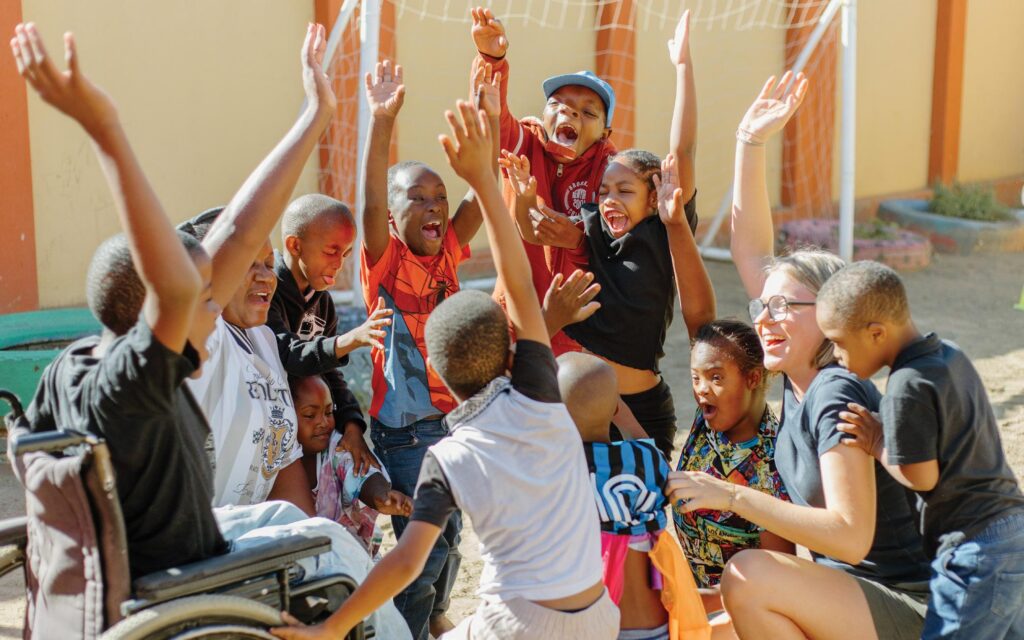
“You are a champion!” The words ring out across the open yard. Jubilant and affirming. Ndangi, one of the teachers at Side by Side Early Intervention Centre, leads the cheer as a group of children jump into action. It is a lively Tuesday morning session, one of two held each week for younger and older groups, where energy and encouragement set the tone from the very start.
A young curly-haired girl with Down’s Syndrome lights up at the call to begin. Without hesitation, she beelines towards a row of cones neatly placed on the sand. With determined strides, she races her opponent from one end to the other, reaching to swoop up the cones from the ground. Around her, teammates and volunteers rally behind her efforts. The interactions are loud and unrestrained, as children tend to be, a little chaotic and distracted at times, with some drifting off before being gently coaxed back to the activity.
Here it is about far more than reaching the finish line.
Building strong foundations
This is the heart of Side by Side Early Intervention Centre, a space for children with intellectual and physical disabilities. Through structured activities and consistent engagement, the centre focuses on early development, helping children build physical, cognitive and social skills in an environment that is nurturing and stimulating.
Established in 2013, the centre has steadily grown from humble beginnings. What started as house visits conducted by a German volunteer on a bicycle, following her work with the Autism Association, gradually evolved into a fully fledged centre rooted in the heart of the community. For Huipie van Wyk, the director of Side by Side, her involvement expanded over time, fuelled by her own search for resources and support after her daughter Elandri was diagnosed with severe brain deformities shortly after birth.
Today, Side by Side runs six programmes each week, reaching approximately 120 children and their families. At its core is a strong focus on education, with 34 children currently enrolled in various learning initiatives. The ECDC programme forms a cornerstone of this work, offering a foundational and often life-changing approach that extends beyond literacy to include tactile, practical life skills. Children learn through doing, whether through everyday activities or hands-on experiences such as preparing kapana over an open fire. Guided by qualified occupational therapists, the programmes are designed to strengthen mobility, build independence and nurture confidence. Physical wellbeing is also prioritised, with initiatives that include dental health check-ups.
Huipie explains that every programme has been intentionally structured to engage multiple aspects of a child’s growth, ensuring a holistic rather than fragmented approach. Behind this work is a dedicated team of 24 staff members, alongside families who are often actively involved in the process of care, feedback and problem solving.
A model that goes beyond charity
For Huipie, the way in which this work is framed matters deeply.
“We are not a charity, but a non-profit. In fact, we are actually a fully operational business which provides an essential service that benefits the community, but we don’t make a profit.” It is a distinction that speaks to sustainability as much as purpose. In a sector often reliant on donor funding, longterm thinking becomes critical. Non-profits, she admits, often “shoot first, aim later” when it comes to budgeting and funding. “Yet we really need reserves in place.” Which is why the need to become self-sustainable is more pressing than ever, particularly as community needs continue to grow.
As Side by Side approaches its thirteenth year, the focus is not only on impact, but on longevity. “Non-profits are supposed to take the issue and see what’s the solution. We are only successful if we manage to work ourselves out of a job. How are we benefitting the children long-term?” It is a question that underpins every programme and decision.
Beyond the practical work lies a deeper mission – one that challenges how disability is perceived and addressed. Traditionally, disability care has been shaped by two dominant approaches. The charity model focuses on meeting immediate needs, while the medical model centres on fixing physical conditions and rehabilitation. While both have value, they can also be limiting. Huipie and her team advocate for a more integrated alternative: the social model.
Rather than asking how to fix the individual, it asks how society can change. It recognises that attitudes, environments and perceptions can either restrict or empower. “You have a place in society. You are worthy. Your disability is not a medical disaster.” Her perspective is rooted in lived experience.
“Raising my daughter was the best qualification. She taught me, at every juncture of her life, what would need to be next. Whether it was education, adequate healthcare or physiotherapy, she really gave us a blueprint on how to care and respond. God doesn’t make mistakes. What if we could change society’s outlook, that this child is not a mistake but someone created with an infinite purpose?”
Since its founding, Side by Side has witnessed a slow shifting in stubbornly ingrained mindsets. There is greater openness, earlier detection in hospitals after birth and a steady erosion of misconceptions often linked to societal stigma or deeply held superstitious beliefs which depicts disability as a curse or a vengeful “payback” for wrongful deeds done in the past.
Yet, the work is far from over.
The power of partnership
A key element of the centre’s work is its partnership with Special Olympics Namibia, a collaboration that has significantly expanded opportunities for the children involved. From Monday to Thursday, children are transported to the Katutura Youth Complex, where the energy shifts to the dynamic world of sport.
This partnership, established three years ago between Side by Side Centre and Special Olympics National Director Levien Smit, is rooted in a shared understanding. Both women have experienced the beauty, bewilderment, pain and wonder of raising children with special needs: a bond that has not only propelled their leadership, but also the depth of their commitment.
Globally, Special Olympics operates in more than 200 countries, engaging millions of athletes with intellectual disabilities. In Namibia, that momentum is steadily building, with approximately 3,000 registered participants across nine regions. Each afternoon, between 14:00 and 16:30, the Katutura Youth Complex comes alive.
At times, up to 80 athletes fill the space, training, competing and, most importantly, growing. While sport is the entry point, the impact stretches far beyond physical activity.
Special Olympics offers year-round training and competitions in a range of Olympic-style disciplines, creating consistent opportunities for athletes to build fitness, resilience and confidence.
“Sport is a great tool to encourage social inclusion and value.” For Levien, the transformation is tangible. “Some of these kids experience a complete personality change!” Namibia’s athletes are already making their mark internationally, having competed in Germany, France, Portugal and Italy. At the 2025 World Winter Games in Italy, the Namibian team placed fourth out of thirteen in the floorball tournament.
Despite these achievements, funding remains a constant need. All programmes are offered free of charge, ensuring accessibility for all participants.
In the pipeline, the organisation is preparing to expand its reach even further. A new initiative, Count Me In, is set to launch later this year in partnership with the Ministry of Education, Innovation, youth, Sports, Arts and Culture, and occupational therapists. The programme will focus on equipping young people with practical, employable skills once they leave school, creating a bridge between participation and independence.
Looking towards 2026, the focus is on strengthening existing programmes while continuing to invest in people. Special Olympics Namibia aims to train up to 200 coaches each year, expanding capacity and reach across the country.
More than a game
There is, however, a persistent misconception that programmes like these exist simply to keep disabled children occupied.
Huipie is quick to challenge this. “This is not a ‘cute social duty’. It is a platform for dignity and real opportunity. There are many examples of young people who, through the Special Olympics, have gained the confidence and skills needed to secure employment.”
Similar to Side by Side, Special Olympics’ approach is inclusive, extending into education, health and leadership. Participants are given meaningful roles within the organisation, reinforcing a sense of ownership. The long-term vision, both women admit, is ambitious.
Plans are underway to build towards a more integrated, multidisciplinary model, combining efforts under an umbrella structure that can be expanded across every region.
The impact of this collaboration is evident in moments like the cone race. What may appear to be a simple exercise carries deeper meaning. It is about showing children that they are capable, that they are strong and that they are, indeed, champions.
It is about creating a future where children of all abilities are not separated from society but fully integrated within it. Seen. Recognised. Valued. Two organisations, distinct yet aligned, working towards a combined goal.
A future where every child knows, without question: You have a place in society. You are worthy.
- Madeleen Duvenhage

