The Bank of Namibia (BoN) has taken significant steps to reinforce its monetary policy framework and deepen regional financial cooperation through a series of developments. These include safeguarding price stability, supporting economic growth and strengthening financial stability.
In a move aimed at strengthening monetary policy formulation, BoN has appointed economist John Steytler as the first independent member of its Monetary Policy Committee (MPC) for a three-year term, as well as Helvi Fillipus as the bank’s youngest MPC member.
Steytler brings more than three decades of national and international economic policy experience. His career includes serving as chief economist and research director at BoN, CEO of the Development Bank of Namibia (DBN), economic advisor to the president and founding statisticiangeneral and CEO of the Namibia Statistics Agency (NSA). He also served as a senior advisor at the International Monetary Fund (IMF), contributing to macroeconomic stability initiatives across Africa.
Meanwhile, Fillipus brings extensive experience and expertise in macroeconomic research, financial markets and public finance. Currently serving as an economic advisor at the bank, she previously advised the minister of finance and holds academic qualifications from the University of Namibia (UNAM) and the University of the Free State (UFS). This development, according to BoN Governor Ebson Uanguta, brings fresh perspectives to the committee as it works to maintain the stability of the Namibian dollar and support sustainable economic growth
MPC decision
At its first bimonthly meeting of 2026, BoN’s MPC met to determine the appropriate monetary policy stance for the next two months. The meeting focused on measures aimed at safeguarding the currency peg between the Namibian dollar and the South African rand, while also supporting the domestic economy. Deciding to maintain the current repo rate at 6.5%, the committee noted that the global economy remained resilient in 2025 despite trade tensions and policy uncertainty, with global growth according to the IMF projected at 3.3% in 2026.
Risks to the global economic outlook remain tilted to the downside, with several factors potentially affecting growth and financial stability. According to the IMF’s world economic outlook update, a reassessment of productivity gains linked to artificial intelligence (AI) could reduce investment and trigger an abrupt correction in financial markets. Such a development could spread from AI-related companies to other sectors, potentially eroding household wealth.
At the same time, rising trade tensions could prolong uncertainty and weigh on global economic activity. Political and geopolitical tensions also pose risks, as they could disrupt financial markets, supply chains and commodity prices. The report further states that fiscal pressures remain another concern, with larger budget deficits and high public debt levels likely to place upward pressure on long-term interest rates and broader financial conditions.
However, there are also potential upside opportunities. Increased investment linked to AI could support economic activity and potentially lead to stronger productivity gains and more dynamic business growth if adoption accelerates. In addition, a sustained easing of trade tensions could further support global economic expansion.
To strengthen stability and support sustainable growth in the medium term, policymakers are encouraged to restore fiscal buffers, maintain price and financial stability, reduce uncertainty and implement structural reforms without delay.
Domestic economy
Commodity prices for some of Namibia’s key exports, including gold, uranium, zinc and copper, increased during the review period. However, diamond prices continued to face downward pressure due to competition from labgrown diamonds and high global inventories. On the domestic front, economic activity slowed during the first three quarters of 2025, largely reflecting contractions in the agriculture, fishing, mining and manufacturing sectors.
Despite this slowdown, inflation remained well contained, declining to 3.5% in 2025 from 4.2% in 2024, and further easing to 2.9% in January 2026. Namibia’s external position also improved, with the merchandise trade deficit narrowing by 35.4% to N$25 billion in 2025, supported by strong export earnings from uranium and gold. Meanwhile, foreign reserves increased to N$51.9 billion at the end of January 2026, providing an estimated 3.3 months of import cover, which the central bank said is sufficient to maintain the currency peg and meet international financial obligations. With the next MPC meeting scheduled for 27 and 28 April 2026, the committee indicated that maintaining the repo rate at its current level remains appropriate to ensure stable capital flows, low inflation and financial stability.
Strengthening regional central bank cooperation
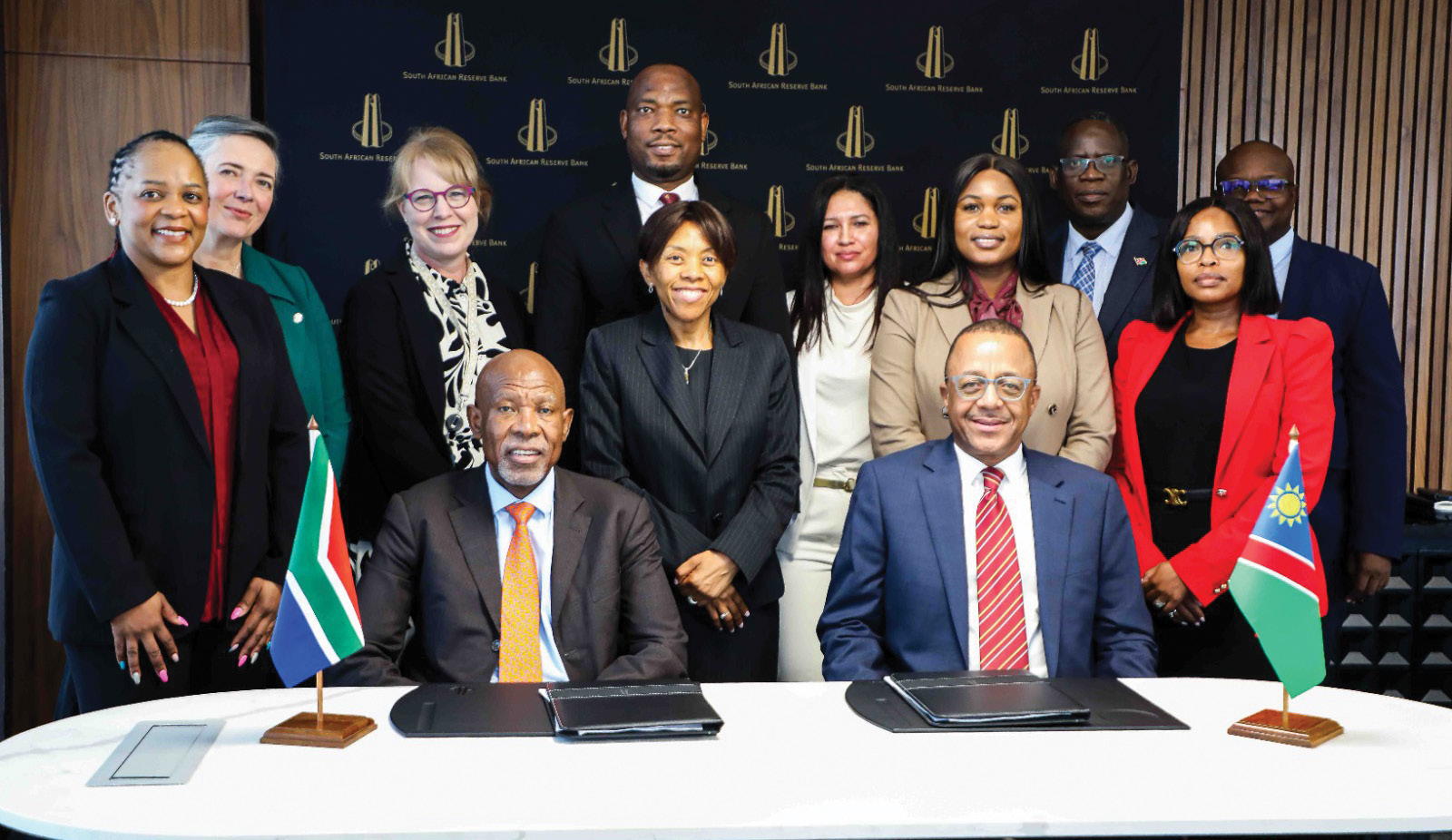
In addition to domestic policy developments, the central bank has also strengthened its regional partnerships by recently signing a revised Memorandum of Understanding (MoU) with the South African Reserve Bank (SARB), aimed at enhancing cooperation between the two institutions.
The agreement was signed in Pretoria, South Africa, by Uanguta and SARB Governor Lesetja Kganyago. The revised MoU replaces the previous agreement signed in 2015 and reflects developments in the financial sector, including strengthened supervisory mandates, improved resolution frameworks and the growing complexity of cross-border financial institutions operating in both countries.
Under the agreement, the two central banks will enhance cooperation in areas such as central banking operations, financial regulation and the supervision of institutions with cross-border activities. It also aims to strengthen regional integration, improve coordination between monetary and fiscal policies, as well as support financial stability. The MoU further focuses on enhancing crisis preparedness, protecting depositors and strengthening coordination between the two institutions. However, the agreement does not create binding legal obligations or limit the statutory independence of either central bank.
Speaking at the signing ceremony, Uanguta noted that the agreement reflects the longstanding relationship between the two institutions and underscores the importance of regional cooperation in maintaining financial stability amid an increasingly complex global financial environment.
Maggie Forcelledo Paz